The Behavior Trap, We All Get Stuck and You Can Find Your Way Out!
Picture this scene at a grocery store check out. The line is long, people are waiting, and there are loads of treats and other mini cheap items waiting to be purchased on impulse.
There’s a young child who spots a candy bar. “Can I please have this?” the child asks nicely. The parents first reply, “Not this time, candy is a special treat.”
The child begins to get louder and louder, whining ensues, crying, the line has not moved an inch. “I want this candy bar now,” screams the child.
The parent’s patience is running thin, people are staring, and the parent is embarrassed. Finally the parent says, “Fine, you can have it.”
Instantly the crying and whining dissipates, the parent feels relief, and the child is happy.
Have you been a part of or observed a scene like this before?
It is an all familiar scene and it’s human nature. People should not feel shame or embarrassment, we have all been there.
Luckily, we can rewrite this scene!
I hear situations similar to this frequently in the classroom. In the Applied Behavior Analysis (ABA) world, this is called the Behavior Trap.
What is the Behavior Trap? It’s a cycle that we got caught in by reinforcing a challenging behavior in order for it to stop which reinforces us!
First, let’s start with the ABCs
- Antecedent: what happens before the behavior
- Behavior: the behavior we are interested in (generally challenging)
- Consequence: what happens after the behavior
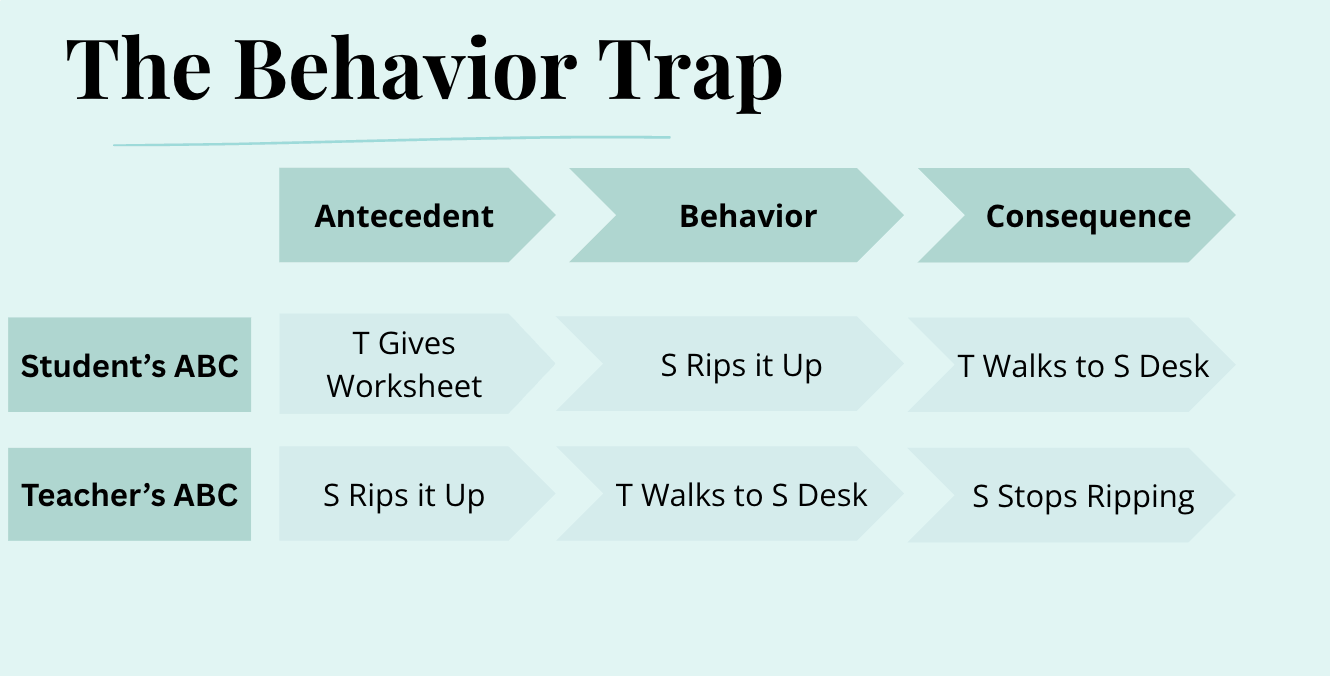
In the visual below, there are two ABCs - the one for the student and the one for the teacher.
The student is handed a worksheet, the student rips it up (they don’t want to do it), the teacher walks over to their desk.
The student ripping up the paper is the teacher’s antecedent, they walk over to the student’s desk, the student stops ripping it up - which reinforces the teacher.
Remember back to the grocery store scene.
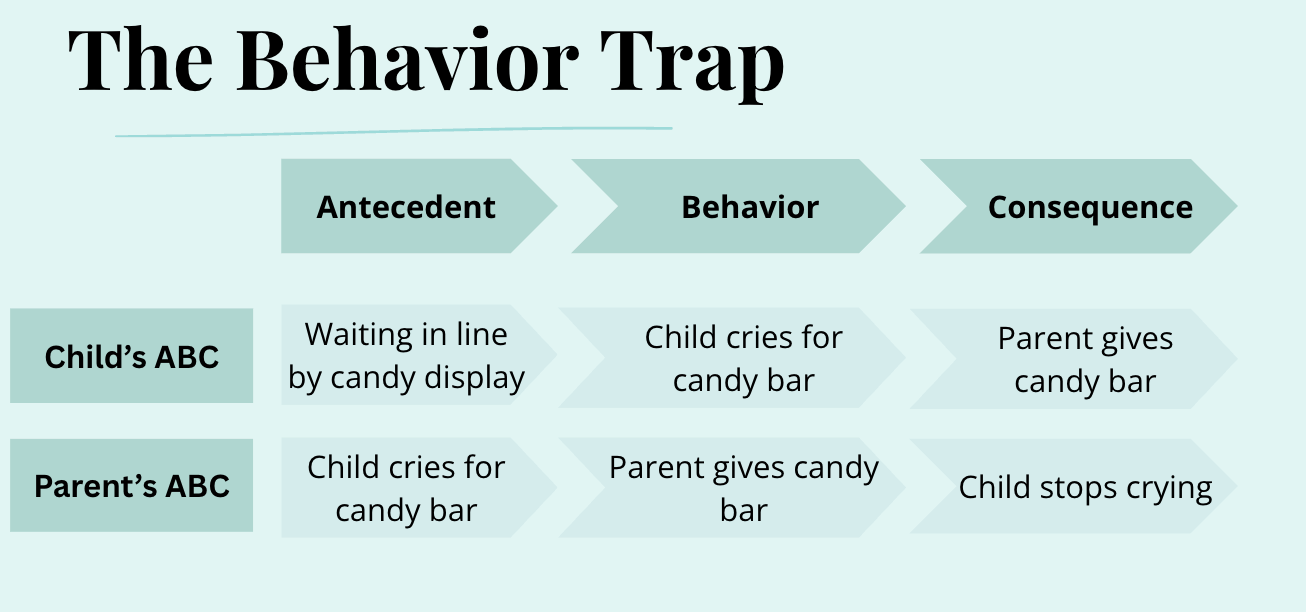
In both scenarios the parent and teacher are reinforced by the challenging behavior stopping. But their behavior is reinforcing the challenging behavior to occur again.
So, how do you know when you are in a behavior trap and how do you get out of it?
- Awareness: you must first know you are in the behavior trap in order to get out of it. If you work with a team, help each other to identify that it is happening, especially if you observe it. You could also reach out to a friend, colleague or me as a thought partner to discuss what’s happening and we can help identify it.
- Alternative Reinforcement: once you know it is happening, remove the reinforcement for the challenging behavior. You can try to prevent it before it happens by offering choices and reinforce the desired behavior.
- Kindness: be kind to yourself and others around you as you make changes to your behavior. Sometimes, when you remove reinforcement from a challenging behavior, it can cause that behavior to increase for a short time before it decreases or hopefully goes away all together.
In the grocery store scene, perhaps the parent gives a reminder before getting to the checkout line, “remember you picked out your one item from the grocery store, that was the pouch.” Or perhaps engage in a distraction or conversation with the child when at the checkout line. Or maybe the child gets to pick out a food item when they get home. Or do a combination of all of these! There are several opportunities to suggest other alternative behaviors and reinforce the child when they engage in the desired behavior.
Once you know you are in the Behavior Trap - you can get out - you just need the tools. So follow the simple three steps above and stop reinforcing the challenging behavior and instead reinforce the desired behavior.
Please reach out if you are looking for a thought partner on recurring challenging behaviors. Contact me here!
I am here to help!
Thanks for reading.