30 Seconds to More Awareness (Without Hour-Long Self-Care Routines)
“Awareness is the birthplace of possibility. Everything you want to do, everything you want to be, starts here.” —Deepak Chopra
Last week I shared one question that has been changing the way I move through my days:
🌟What is happening to my nervous system right now? 🌟
That simple question helped me notice patterns I had not thought about before. (If you missed it, you can read it here.)
One thing I’ve learned over the years, and that continues to be reinforced in my Applied Educational Neuroscience coursework, is that awareness is the first step.
So how do we become more aware?
One way is by intentionally practicing tiny moments of steadiness while we are already regulated. Just like we teach students to practice regulation skills before they need them, adults benefit from doing the same.
If you teach a social/emotional curriculum or social/emotional IEP goals, you already know that regulation skills are practiced when students are calm so they can access them when they are dysregulated.
The same is true for us as adults.
By practicing small moments of steadiness - slowing our breath, noticing our body, becoming present - we strengthen the pathways we’ll need when stress inevitably shows up. Then, instead of reacting automatically, we’re more likely to notice what’s happening, pause, and choose how we want to respond.
This is not hour-long self-care routines.
This is not adding one more thing to an already full plate.
In my Applied Education Neuroscience program, they call these Focused Attention Practices (FoAPs).
These come in all shapes and sizes. Some are for adults, some for students. Some are done alone, while others are done with a group. Some involve creating or crafting, while others simply use your body and breath.
There isn’t one “right” practice. Pick the one that fits you, the one that you will actually do.
As part of my coursework, I created my own Focused Attention Practice: Celebrate & Release
Here’s the practice. It takes about two minutes!
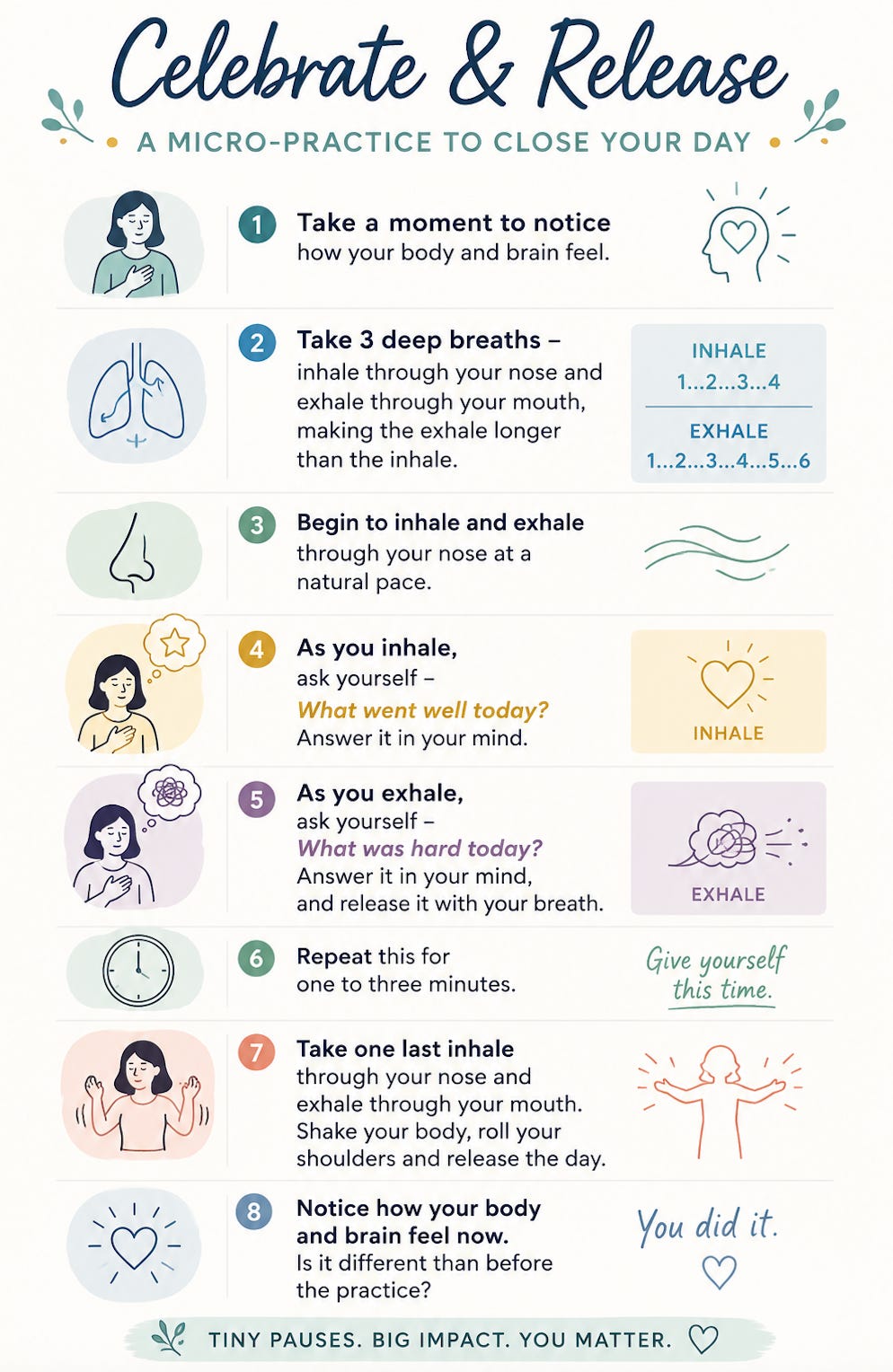
I first started this practice every night before bed with my six-year-old son.
Our version is much simpler. We answer two questions:
-
What was good about your day today?
-
What was hard about your day today?
Sometimes his answers surprise me. Sometimes I learn about something that happened hours earlier but he never mentioned.
Every night, his answers give me a little more insight into his world.
I’ve learned about friendships that are becoming important, games he wants to play again tomorrow, worries he carried throughout the day, and little disappointments that seemed insignificant to me but felt really big to him.
It’s become one of my favorite parts of our bedtime routine.
Looking back, I realize we’re doing much more than talking about our day.
We’re helping our nervous systems close out the day instead of carrying everything into tomorrow.
This same idea applies to educators.
Teaching asks us to absorb hundreds of interactions every day. Some joyful. Some frustrating. Some emotionally exhausting.
-
The student who continued to not understand a concept.
-
The difficult IEP meeting.
-
The behavior that escalated.
-
The difficult conversation with a colleague.
-
The email you wish you hadn’t read at 3:45.
Without realizing it, we carry these moments home and into our lives the next day and the next day.
By intentionally acknowledging and releasing these challenging moments, we’re less likely to replay them over and over, creating more mental space for the next day.
We’re helping our nervous systems regulate.
A longer exhale activates the vagus nerve, helping shift our body toward the parasympathetic state - the body’s natural “brake pedal.”
Reflecting on what went well also supports neuroplasticity by strengthening neural pathways associated with resilience and coping rather than allowing our brains to replay only the stressful moments.
And acknowledging what was hard is just as important.
We’re not pretending difficult things didn’t happen.
We’re simply choosing not to carry all of them into tomorrow.
As educators, our nervous system doesn’t just affect us.
It affects every student who walks into our classroom.
The more often we practice returning to steadiness, the more available we become to co-regulate with others.
Sometimes the most powerful practices aren’t the biggest ones.
They’re the ones we’ll actually do.
I’m excited to continue sharing more Focused Attention Practices from the Brain & Body Brilliance Manual throughout this next year. Each one is simple, practical, and designed to support the nervous system regulation of both educator and student.
I’d love to hear from you
What small practice already helps you regulate your nervous system?