What is Applied Educational Neuroscience and How Can We Use it as a Superpower?
"Go inside and listen to your body, because your body will never lie to you. Your mind will play tricks, but the way you feel in your heart, in your guts, is the truth." - Miguel Ruiz
Last week was the intensive week for the new program I enrolled in, Applied Educational Neuroscience (AEN), and wow - I am super excited!
It felt like drinking water from a fire hose. I am still processing everything I learned, connecting it to my experiences as a special education teacher, behavior analyst, and compassion educator.
Some of you might be wondering: What exactly is Applied Educational Neuroscience?
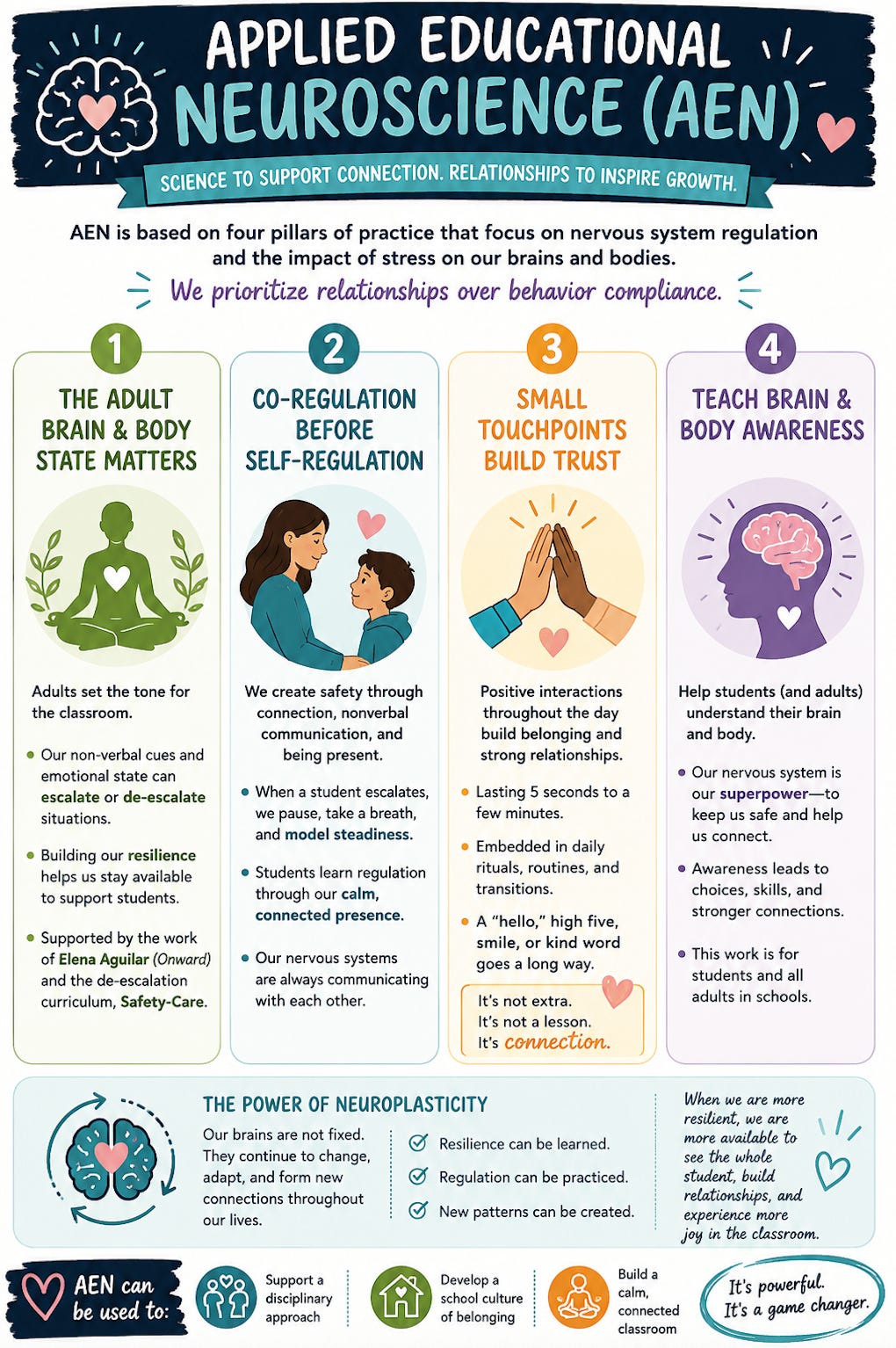
At its core, AEN is built on four pillars that focus on nervous system regulation and the science of how stress and trauma impact our brains and bodies. Rather than prioritizing behavior compliance, it prioritizes relationships, safety, and connection.
Why I love it so much? It feels like someone took everything I’ve been observing and practicing over the last 18 years in education and added neuroscience to explain why it works.
Pillar 1: The Adult Brain and Body State Matters
The first pillar focuses on the adults. Our nervous systems directly influence the students around us. Our facial expressions, tone of voice, body language, and emotional state communicate far more than our words ever will.
When we are dysregulated, we can unintentionally escalate situations. When we are grounded, we create safety. This means that building resilience as educators isn’t selfish, it’s necessary. The more regulated we are, the more available we become for our students.
This aligns with so much of the work I’ve already shared, including Elena Aguilar’s Onward.
Pillar 2: Co-Regulation Before Self-Regulation
The second pillar focuses on co-regulation. Students learn to regulate through relationships with calm, connected adults. When you notice a student escalating, the goal isn’t to match their energy or control their behavior. Instead, we take a breath, slow ourselves down, and model what steadiness looks like.
Think about your own relationships. When you’re upset, does it help if the other person escalates with you? Or does it help when they remain calm, present, and connected?
The same principle applies in our classrooms. Our nervous systems are constantly communicating with one another.
Pillar 3: Small Touchpoints Build Trust
The third pillar emphasizes intentional touchpoints throughout the day. These are positive interactions that last anywhere from a few seconds to a few minutes and can be naturally embedded into daily routines and transitions.
A smile. A high five. A quick “I’m glad you’re here.” A moment of genuine curiosity about a student’s life.
These moments may seem small, but they build trust, belonging, and psychological safety over time. They aren’t one more thing to add to your already overflowing to-do list. They’re simply opportunities to be more intentional with the moments that already exist.
Some of these activities you are already practicing, this just gives you the science and reasoning to keep doing it and do more!
Pillar 4: Teaching Brain and Body Awareness
The fourth pillar focuses on helping students and adults understand their own nervous systems. Our brains and bodies are designed to keep us safe and help us connect with others. When we understand how stress affects us, we can begin to recognize our patterns, build new skills, and respond more intentionally rather than react automatically.
When we understand how our brains and bodies work, we know that a challenging behavior isn’t manipulation, lazy or out to get us but instead we know that it is a form of communication, a plea for help, or an insight into the person’s sensations.
This work isn’t just for students. It’s for all of us.
This is a practice, a journey to continually understand our nervous systems.
Underneath this work lies the power of neuroplasticity. Neuroplasticity means that our brains are not fixed. They continue to change, adapt, and form new connections throughout our lives.
That means resilience can be learned. Regulation can be practiced. New patterns can be created.
The more resilient we become as educators, the more available we are to see the whole child, build authentic relationships, and experience joy in our work again.
What I love most about Applied Educational Neuroscience is that it brings together so many ideas that have shaped my work over the years.
It supports calm classrooms. It strengthens school culture. It deepens our understanding of behavior. It looks beneath the behavior at what is happening physiologically inside our bodies.
It helps us move from asking, “What’s wrong with this student?” to asking, “What is this student communicating, and how can we create safety?”
Most importantly, it gives us the science to support what many educators have known in their hearts all along: Relationships come first. Everything else grows from there.
I’m excited to continue learning and sharing this journey with you.
I’d love to hear your thoughts. Which of these four pillars resonates most with your experience in education?
Message Kristy Banks